

Why it feels so hard—and what actually helps
by Wendy Wright, LMFT, Financial Therapist, Money Coach, and Money Story Specialist™
Founder of the Wendy Wright Financial Therapy Approach™ | Creator of the 10 Principles of Financial Therapy©
Struggling with business finances, or experiencing business finances stress isn’t just about numbers.
For many women entrepreneurs, it’s driven by an emotional relationship with money—one that quietly shapes decisions, avoidance, and stress far more than strategy alone.
A quick moment you might recognize
I often think of a client I’ll call Claire.
She’s smart, capable, deeply passionate about her work. The kind of woman who shows up fully for her clients.
And yet… when it comes to her business finances?
She suddenly remembers emails she needs to answer.
Her kitchen becomes very interesting.
Anything feels easier than opening up her numbers.
Not because she doesn’t care.
Because something about money feels… loaded.
If you’ve ever had a moment like that, you’re not alone.
This is exactly what we talked about on the podcast
I was recently a guest on The Women Empower Podcast with Bri Logue, where we explored the connection between your business, your mind, and your money. Listen here on Apple podcasts:
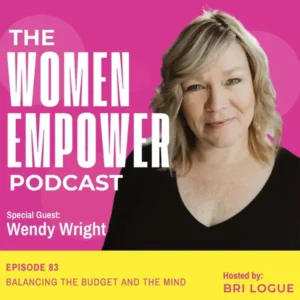
We talked about:
- how financial therapy began
- my own path—from business to mortgage lending to therapy to money coaching
- and why I developed my own Financial Therapy Approach™
(And yes, there’s a quick story about riding my bike around Elvis’ house—because this work gets to be human, too.)
But underneath all of it was this:
Your business finances are never just about your business.
Why your business finances can feel so complicated
In my work, I tend to see one of two patterns:
Sometimes it feels separate
Like your business money and personal money follow completely different rules.
You “should” know what to do in your business…
but it doesn’t always match how money actually feels to you.
That disconnect can create pressure, confusion, and quiet self-doubt.
Sometimes it feels tangled
Other times, everything blends together.
Your revenue feels tied to your worth.
Your business performance feels personal.
And this is where what I call money fog shows up—
that sense of overwhelm, avoidance, or not quite knowing where to start.
A gentle reframe
If any of this resonates, here’s something I want you to hear clearly:
You’re not bad with money.
You’re responding to money in a way that makes sense based on your experiences.
In my Wendy Wright Financial Therapy Approach™, we don’t start by trying to fix that.
We start by understanding it—with compassionate curiosity and zero judgment.
Because when you understand the “why,” everything else becomes more workable.
What makes my approach different
There are a lot of conversations happening about financial therapy right now.
My work is informed by that field—but it’s also shaped by something broader:
- a degree and background in business
- hands-on experience in the mortgage and financial world
- over two decades as a licensed therapist
- and years of money coaching
So what I’ve created is an approach that integrates:
- your numbers (what’s actually happening in your business)
- your emotions (how money feels in your body and mind)
- and your money story (where those patterns began)
Because focusing on just one of those rarely creates lasting change.
What this looks like in real life
When I work with women entrepreneurs, we don’t jump straight into spreadsheets.
We start by reducing the fog.
Often within 3–6 sessions, I see clients begin to:
- connect current behaviors to past experiences
- understand why avoidance shows up
- feel more grounded when looking at their numbers
From there, we build new ways of interacting with money that feel more:
- connected
- aligned
- and sustainable
If you want a place to begin, start here
Not with fixing. Just with noticing.
You might reflect on:
- When I ask if you know your top five business numbers, what happens in your body?
- What emotions come up—fear, avoidance, curiosity, excitement?
- What amount of money do you need your business to support your life?
- What amount do you want it to support?
- Do you have a 12-month plan that connects your work to those numbers?
And as you answer…
Pay attention to the feelings.
Because those feelings aren’t in the way.
They’re part of the information.
If you want to go a little deeper
You might also explore:
These will help you begin to understand the patterns behind what you’re experiencing.
A final thought
Most business advice tells you what to do.
Fewer places help you understand why it feels so hard to do it.
That’s the work I do.
Ready to explore this in a way that actually feels different?
If something in this resonated, that’s a good place to start.
I offer a free 20-minute Money Clarity Call—a simple, supportive conversation where we can:
- talk through what’s feeling stuck in your business finances
- begin to understand what might be underneath it
- and see if my Financial Therapy Approach™ feels like the right fit for you
There’s nothing you need to prepare.
And nothing you need to figure out ahead of time.
Start with a conversation, not a commitment.
BOOK Your Money Clarity Call
No pressure. No judgment. Just a conversation.
FAQ: Financial Therapy for Entrepreneurs & Business Owners
Financial therapy helps you understand the emotional, behavioral, and psychological relationship you have with money. For entrepreneurs and business owners, financial therapy can help reduce financial anxiety, improve decision-making, address money shame, and create healthier patterns around earning, spending, pricing, debt, and growth.
Financial stress can impact everything from pricing your services and paying yourself to avoiding financial planning, overspending, undercharging, or making fear-based business decisions. Many entrepreneurs unknowingly operate from money patterns rooted in anxiety, scarcity, perfectionism, or shame, which can directly affect business growth and sustainability.
Yes. Financial therapy can help business owners identify the emotional triggers and beliefs driving money anxiety. Instead of only focusing on spreadsheets or budgeting strategies, financial therapy explores the underlying emotional patterns that may be contributing to stress, avoidance, fear, or burnout around money.
Many business owners avoid their finances because of overwhelm, shame, fear of failure, perfectionism, or fear of what the numbers might reveal. Avoidance is often not a lack of intelligence or capability — it is usually an emotional protection response connected to past experiences, stress, or money beliefs.
Some common struggles include difficulty paying themselves consistently, fear of raising prices, avoiding financial planning, overspending or underspending in business, shame around debt, inconsistent income anxiety, and feeling alone in managing the emotional side of entrepreneurship.
Financial therapy can help entrepreneurs build greater self-trust, emotional awareness, and confidence around financial decision-making. As business owners begin to understand and shift their money patterns, they often feel more capable, grounded, and empowered in both their personal finances and their business leadership.
No. Financial therapy is not only for people experiencing severe financial problems. Many high-functioning entrepreneurs, professionals, and business owners seek financial therapy to improve their relationship with money, reduce stress, increase clarity, and create healthier financial habits and decision-making patterns.
Financial therapy may help if you experience ongoing stress, avoidance, shame, fear, overwhelm, emotional spending, under-earning, difficulty making financial decisions, or anxiety around business finances — even if your business appears successful from the outside.
Your financial mindset influences how you earn, spend, save, invest, price your services, and respond to financial stress. Business owners often carry unconscious beliefs about worthiness, security, success, or scarcity that directly impact business growth and financial behaviors.
Yes. Many entrepreneurs quietly carry stress, fear, shame, or uncertainty around money. Financial therapy provides a supportive space to explore these experiences without judgment, helping business owners feel more understood, emotionally supported, and less isolated in their financial journey.