
Many people assume their relationship with money is primarily about numbers — income, expenses, savings, and decisions.
But after years of working with clients, I can tell you something that often surprises them:
Money is rarely just about money.
Money is emotional before it is logical, and those emotional patterns often begin forming long before you ever earn your first dollar.
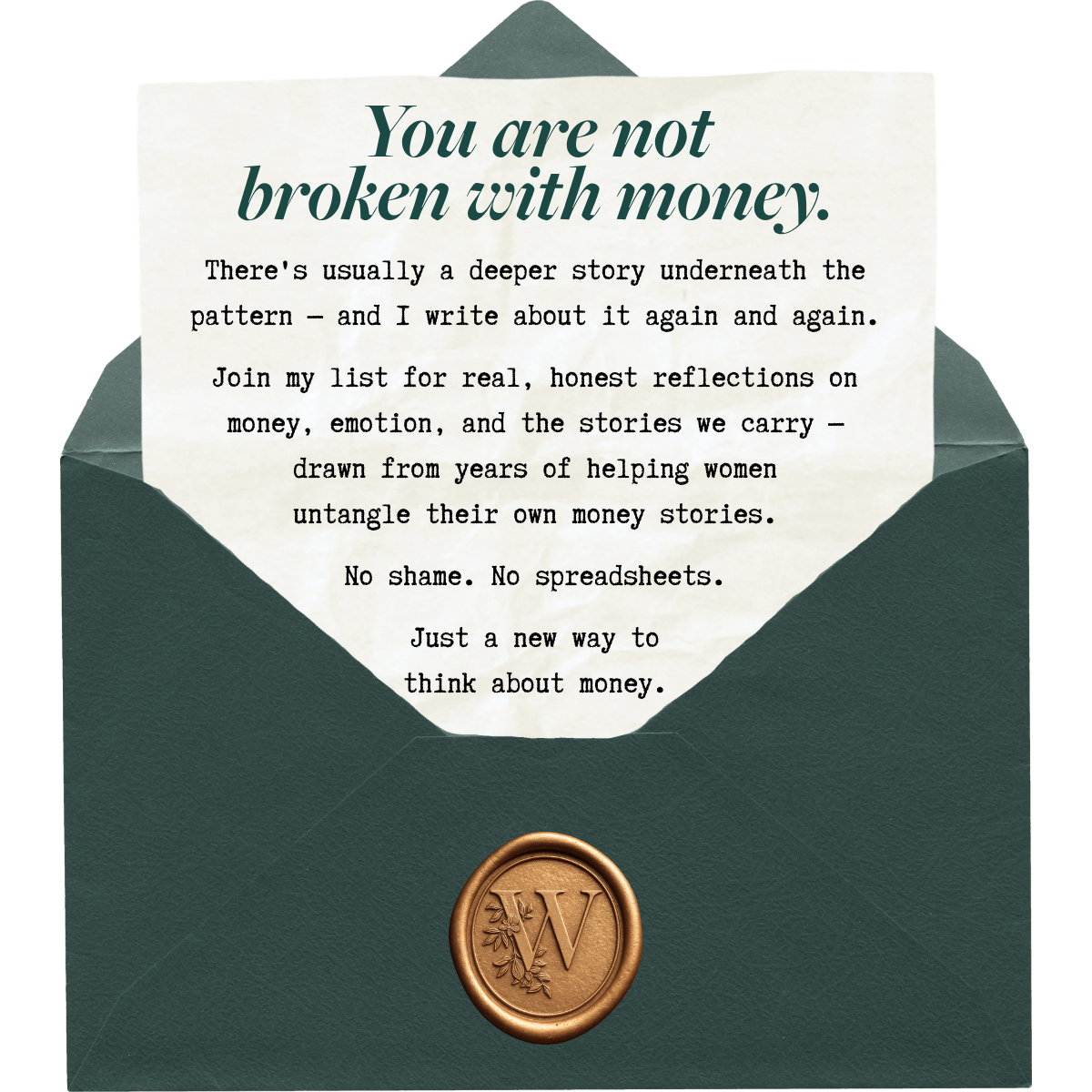
This is what I call your money story.
Your money story is the collection of beliefs, experiences, and emotional associations you carry about money — often without realizing it. It shapes how safe you feel, how you make decisions, how you show up in relationships, and how you interpret success, responsibility, and worth.
And most importantly, it influences what feels possible in your life.
Through the lens of financial therapy, we begin to understand that money patterns are not just about knowledge or discipline. They are shaped by lived experience, emotional memory, and the meaning we attach to security and survival.
Claire’s Story: When Nothing Looks Wrong on Paper
For the sake of this story, let’s say I have a client named Claire.
Claire came to me feeling stuck.
On paper, everything looked fine. She had built a successful business, was earning more than she ever had before, and was thoughtful and responsible with money.
But internally, something didn’t feel right.
She described a quiet, persistent pressure — feeling behind, even when she wasn’t, second-guessing decisions, hesitating to spend money on herself, and feeling responsible for getting everything “right.”
At one point, she said:
“I feel like I should feel more confident than I do.”
Claire didn’t initially think she had a money story. There was no obvious financial trauma, no major mistakes, and nothing dramatic that explained how she felt.
But as we began exploring her experiences, patterns started to emerge.
Money hadn’t been talked about openly growing up. There was a subtle sense that it needed to be handled carefully. Success was expected, but enjoying it felt uncomfortable.
She absorbed messages like:
being responsible means being careful
wanting more might feel excessive
security requires constant vigilance
No one explicitly taught her these things — but she felt them. And over time, they shaped how she related to money and to herself.
What Exactly Is a Money Story?
Your money story is the emotional framework through which you understand money.
It includes what money represented growing up, how money was talked about (or avoided), experiences of stability or uncertainty, and the messages you absorbed about success, responsibility, and security.
These experiences influence how you interpret financial situations today — often outside of conscious awareness.
Your money story develops through observation, tone, and emotional experiences just as much as direct instruction. Even people who grew up in financially stable environments carry powerful money stories, because meaning is shaped by emotional atmosphere as much as circumstance.
How Money Patterns Show Up Beyond Finances
Money patterns rarely stay contained to financial decisions. They often appear in other areas of life, sometimes in ways that don’t immediately seem connected to money.
You might notice patterns like:
- difficulty setting boundaries
- overworking or under-earning
- feeling behind no matter how much you accomplish
- avoiding important conversations
- pressure to make the “right” decision
- linking self-worth to productivity
- feeling responsible for everyone else
When Claire began recognizing her patterns, she realized something important:
Her stress wasn’t coming from the numbers — it was coming from what the numbers meant to her.
Many people describe a similar experience. They feel like they are never quite secure, never quite finished, or never quite enough, even when things look stable from the outside.
If this resonates, you may also see similar patterns explored in this article on the emotional relationship with money.
When we begin to understand the emotional layer beneath financial behavior, these patterns start to make sense — not as personal failings, but as adaptive responses to earlier experiences.
Money, Relationships, and Emotional Safety
Money stories don’t just affect finances — they influence how we relate to other people.
They shape how safe you feel asking for help, receiving support, setting boundaries, and having conversations about needs or expectations.
Claire noticed she struggled to invest in support for her business. Not because she couldn’t afford it, but because it didn’t feel safe.
Underneath that was an early association: responsibility meant self-reliance.
Her nervous system interpreted support as risk, even when she logically knew it could help her grow.
When you begin to understand your money story, relationship dynamics often become clearer and easier to navigate.
Do You Need Financial Trauma to Have a Money Story?
No — and this is one of the most important things to understand.
A money story does not require hardship to be meaningful. It can form in subtle ways — through what wasn’t discussed, the emotional tone around money, or the expectations you absorbed growing up.
External stability does not always create internal ease.
Whatever shaped your earliest understanding of money is part of your story, and it matters.
Understanding Your Money Story Isn’t About Blame
We look back for context, not for blame.
When you understand where a pattern came from, something begins to shift. You create space between the trigger and your response.
Instead of reacting automatically, you begin to respond more intentionally.
Claire described this shift simply:
“I feel like I have more room inside my decisions.”
That shift — from reaction to response — is where meaningful, lasting change happens.
Where the Work Begins
We begin with something most people aren’t used to: compassionate curiosity without judgment.
This reflects one of the core principles that guide Wendy Wright’s approach to financial therapy.
There is no shame. No pressure to “fix” everything quickly. No expectation that you should have known better.
Instead, we explore your experiences, your patterns, and your emotional responses to money. We begin to understand how your story developed — and how it is operating in your life today.
Over time, many clients notice more clarity, more confidence, and more self-trust. Not because everything externally changes overnight, but because their relationship with money changes.
A Gentle First Step
If you’re curious about your own money story, you don’t need to have everything figured out before starting.
You can begin with a simple conversation.
During a free 20-minute discovery call, we explore what has been feeling challenging, what you want to feel different, and what support might look like.
If you’d prefer to start on your own, the Money Shadow Quiz is a gentle way to begin noticing your patterns.
Understanding your money story often leads to a deeper understanding of yourself — and from that understanding, new choices become possible.
Book a Discovery Call
If something in this resonated with you, you’re invited to take the next step.
👉 Book your free 20-minute Discovery Call here
Frequently Asked Questions About Money Story and Financial Therapy
Everyone has one.
Your money story is the set of beliefs, emotions, and patterns you’ve built around money over time — often unconsciously.
It begins early, through what you experience, observe, and absorb about money, security, and worth.
It often shows up outside of money.
You might notice:
difficulty setting boundaries
feeling behind
avoiding conversations
linking worth to productivity
These patterns often have deeper roots connected to money meaning.
No.
Money stories form in subtle ways too — through emotional tone, silence, expectations, and unspoken beliefs.
No.
We look at the past to understand patterns — not to relive them.
The goal is to create more choice in how you respond moving forward.
Start with curiosity.
You can begin with a discovery call or explore your patterns through the Money Shadow Quiz.