

Watch Wendy’s Webinar
If you’ve ever wondered why financial progress hasn’t brought the peace, confidence, or relief you expected, I’d love for you to join me for this free Purse Strings Money Talks webinar.
We’ll explore how the beliefs we carry about money quietly shape our decisions, emotions, and financial well-being—and what it takes to create lasting change.
by Wendy Wright, LMFT, Financial Therapist, Money Coach, and Money Story Specialist™
Founder of the Wendy Wright Financial Therapy Approach™ | Creator of the 10 Principles of Financial Therapy©
On June 18th, I am joining the Purse Strings Money Talks webinar — and I want to tell you why I said yes without hesitation, and why I would love to have you join me.
Purse Strings was created because women kept telling financial professionals the same painful things: “They don’t even look at me.” “I feel like prey.” “They just want my money.” When the team at Purse Strings reached out to me, wanting me to be their first financial therapist in the approved professional directory, I could sense they listened — really listened — to the struggles women were having. And then built something different. A place to learn without judgment. A space to ask real questions without being talked down to.
That is also exactly why I do this work. And it is why I think this conversation — on June 18th, 2026, — is one worth showing up for. You can register at pursestrings.co and join us live. If you’re not able to attend, the full webinar and recap will be available here.
For over a decade, through my specialized financial therapy approach, I have been helping women move out of shame-based money mindsets and into something that actually feels like freedom. Not just financial freedom as a number — but as a feeling. So when Purse Strings asked me to come talk about money beliefs and what keeps smart, capable women — just like you and me — stuck, I knew we were going to go somewhere most financial conversations are too afraid to go. Here are some of the highlights we will discuss.
Budgets Don’t Fix Beliefs
You hear a lot about budgets, investments, and financial strategies. And those things matter. But if the story underneath your money behavior is still running the show, no spreadsheet is going to reach it.
Before anyone talks to you about what to do with your money, I invite you to talk about what you believe about your money — and where those beliefs actually came from.
I want you to try something right now. Think about how money was talked about — or not talked about — in your house growing up. What is the first word that comes to mind?
Sit with that for a moment. Because that word is often the beginning of your money story.
What a Money Story Actually Is
A money story is the invisible script you inherited about what money means, who deserves it, and whether you are safe with it. It comes from childhood, family, culture, religion, and sometimes trauma. And it shows up in your adult financial behavior — often without you even noticing it is there.
Here is the important distinction: a money behavior is what you do. A money story is why you do it.
You can’t change a pattern you can’t name. The first step is never fixing the budget. It is identifying the story underneath the budget.
I carried two main money messages growing up. One was subtle, never spoken out loud — something like just don’t spend money. It was confusing, because I also watched my parents build a comfortable life. There were trips, a warm home, good schools. But alongside those things were constant comments about things being too expensive. I didn’t realize I was absorbing a mixed message until I was an adult staring at my own paycheck, unsure what to do with it.
The second message came from out of my history with a religious background — from things such as Dave Ramsey’s materials and the idea that debt is bad, full stop. When I eventually had credit card debt, that message didn’t motivate me to pay it off. It poured shame onto my nervous system. And shame, I have learned, is not a money strategy. It never has been. [Religiosity isn’t a part of my beliefs, and the levels of shame played a big part in my disconnect from that system.]
You cannot shame yourself into financial peace.
How Your Money Story Shows Up Day to Day
Money stories don’t stay in the past. They travel with you into every financial decision you make today.
Overspending, underearning, financial paralysis, hoarding, avoiding — each of these behaviors has something underneath it. Each one is the nervous system trying to do something: stay safe, feel comfort, avoid loss, maintain control. The behavior is not the problem. It is the signal.
This is especially true in relationships. When two people with different money stories try to build a financial life together, those stories don’t just coexist — they collide. What looks like a disagreement about spending is often two different nervous systems responding to two very different childhood messages about safety and survival.
Notice the feeling before the financial decision. That feeling is usually the story talking.
How to Start Rewriting Your Money Story
In my unique financial therapy approach, healing moves through three phases: awareness, exploration, and new narrative. Most people skip straight to the new narrative — the goal, the plan, the budget — without ever going through the first two. That is why the change doesn’t last.
If you want to go deeper on what a money story actually is and how it forms, I wrote about that here: Your Money Story.
Here is where to start:
Name one belief you’ve been carrying. Write it down. Don’t judge it. Just name it.
Then ask: Is this actually mine? Or did I inherit it?
Once I worked through my own money story — really worked through it, not just read about it — I stopped experiencing shame around debt. My nervous system calmed. And from that calmer place, I was able to make a real plan. Not a plan born of panic or self-punishment, but a plan that actually reflected my values and my life.
That is what emotionally sustainable financial change looks like.
What Financial Healing Actually Looks Like
You might be wondering what financial healing actually looks like in real life. Here is what I see in session, often:
A woman comes in talking quickly. Her words are moving fast, her shoulders are up around her ears, her sentences are running together. That pace is anxiety doing its job — managing, containing, staying one step ahead of the shame.
And then something shifts. We name the story. We look at it without judgment. We separate her from the belief she inherited.
Her shoulders drop. A long, slow breath moves through her. Her words come more slowly, with more space between them.
That moment — the shoulders dropping, the sigh, the slowing down — that is what financial healing looks like. It is a nervous system finding safety. And from that safety, everything becomes more possible. If you are curious about what that healing process can look like for you, this post is a good place to start: Can You Heal Your Relationship with Money?
Financial freedom isn’t just a number. It is a feeling. And you can start building it today.
Your Next Step
If something in this post landed for you — if you felt a flicker of recognition around a belief you’ve been carrying — I’d love to help you look at it more closely.
A gentle place to start is my free Money Shadow Quiz at wendywrightfinancialtherapy.com/quiz. It takes just a few minutes and can help you begin to see which patterns are most alive for you right now.
And if you’re ready to go deeper, I invite you to schedule a discovery call at wendy-wright.clientsecure.me/request/service. There is no pressure, no pitch — just a conversation to see if working together makes sense for you.
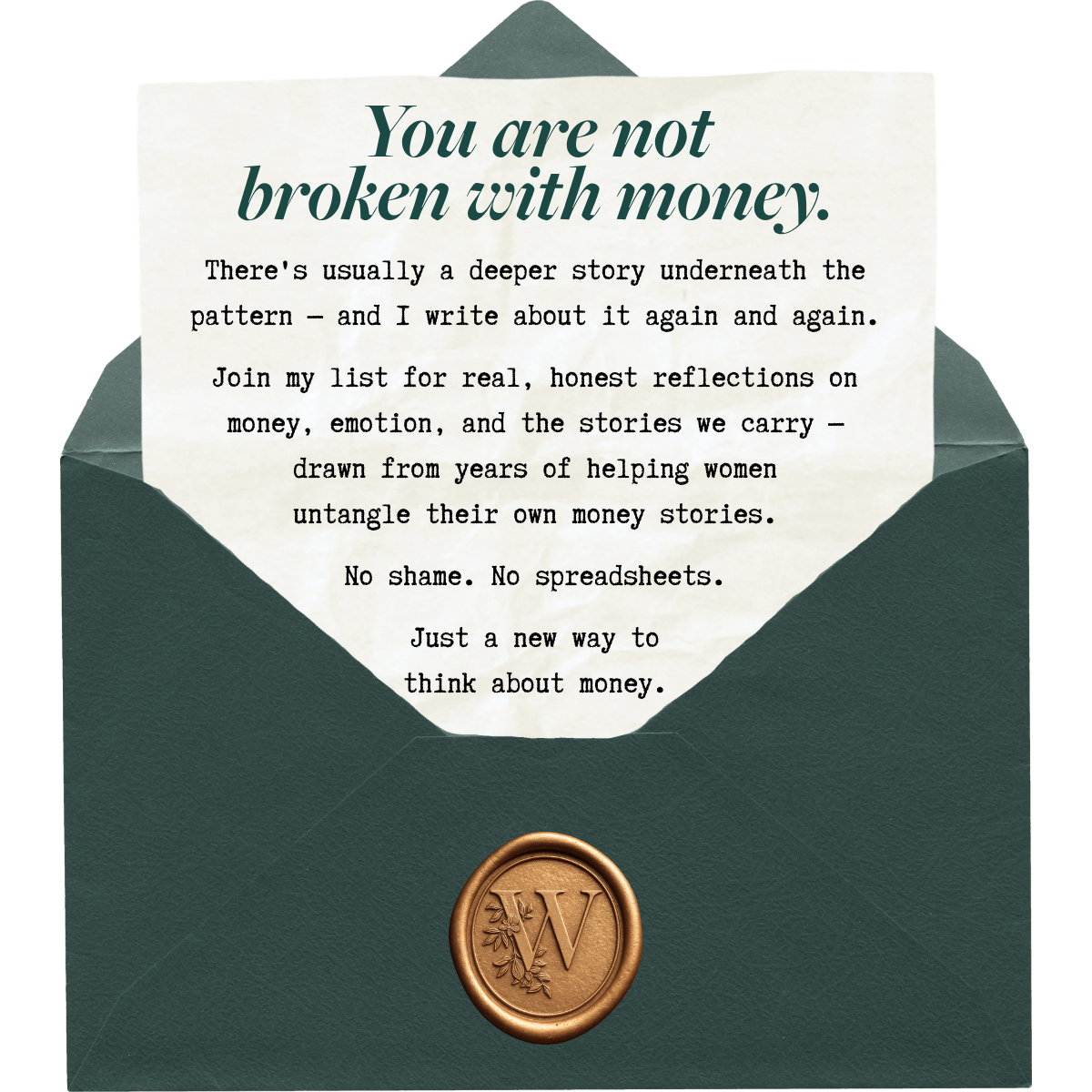
You are not broken with money. There is usually a deeper story underneath the pattern. And that story can be rewritten.
Wendy Wright, LMFT, is a Financial Therapist and Money Story Specialist™ with over 10 years of experience as one of the first dedicated financial therapists in the nation. She works with clients worldwide through the Wendy Wright Financial Therapy Approach™ at wendywrightfinancialtherapy.com.
Frequently Asked Questions About Money Stories and Financial Therapy
A money story is the collection of beliefs, emotions, and assumptions you learned about money throughout your life. These beliefs often come from childhood experiences, family dynamics, culture, religion, and significant financial events. Your money story influences how you earn, spend, save, invest, and talk about money today.
Signs that money beliefs may be influencing your financial decisions include financial anxiety, overspending, undercharging for your work, avoiding financial conversations, difficulty saving, guilt around spending, or feeling stuck despite having financial knowledge. Often, the emotional reaction to money is a clue that a deeper belief is driving the behavior.
Yes. Financial therapy helps individuals explore the emotional and psychological factors behind money stress. Rather than focusing only on budgeting or financial strategies, financial therapy helps uncover the beliefs, fears, and experiences contributing to money anxiety so lasting change becomes possible.
Financial planning focuses on what to do with your money, such as budgeting, investing, retirement planning, and financial goals. Financial therapy explores why you make certain financial decisions by examining your emotions, beliefs, relationships, and experiences with money. Many people benefit from addressing both the practical and emotional sides of money.
Many people assume money stress only happens when finances are objectively difficult. However, money anxiety is often connected to beliefs, past experiences, family messages, or fears about security and self-worth. Even individuals with healthy incomes and savings can experience significant financial stress if unresolved money stories are still influencing their thinking.
Yes. Childhood experiences often shape the foundation of your money story. Messages about spending, saving, debt, success, scarcity, or financial security can become deeply ingrained and continue influencing financial decisions well into adulthood, often without conscious awareness.
Money stories can create conflict when partners have different beliefs about spending, saving, debt, risk, or financial security. What appears to be a disagreement about money is often a clash between two different experiences and emotional histories. Understanding each partner’s money story can improve communication and reduce financial conflict.
The first step is awareness. Identify a money belief you regularly hear in your own thoughts, such as “I’m bad with money” or “I’ll never have enough.” Then ask yourself where that belief originated and whether it is still serving you. Through reflection, support, and intentional practice, it is possible to develop a healthier and more empowering relationship with money.
A Money Shadow is a recurring pattern, behavior, or emotional response to money that operates largely outside of conscious awareness. Examples include avoidance, perfectionism, overspending, scarcity thinking, or financial self-sabotage. Understanding your Money Shadow can help you uncover the deeper beliefs driving your financial behavior.
Yes. Healing your relationship with money involves understanding the emotional experiences, beliefs, and patterns that shape your financial life. Through awareness, curiosity, and intentional change, many people find greater confidence, peace, and freedom in their relationship with money.