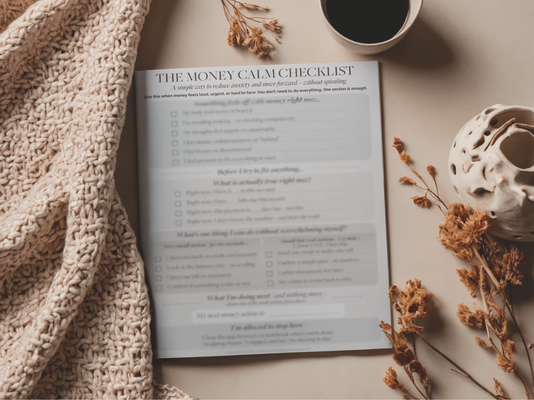

Healing Begins When We Take the “Money Word” Out of the Sentence
By Wendy Wright, Financial Therapist & Money Story Specialist™
My Financial Therapy Approach builds from my 10 Principles of Financial Therapy©.
Let’s start with one of my favorites:
“Take the money word out of the sentence.”
This practice helps deepen your relationship to the feelings beneath money words — the sensations, memories, and emotions that shape how you spend, give, or avoid.
When clients first hear this, they often ask, “How can I talk about money without talking about money?”
Here’s how.
Why Feelings Come First
In Financial Therapy, numbers aren’t the main story — meaning is.
When we use words like “expensive,” “cheap,” or “broke,” we’re rarely talking about dollars.
We’re describing feelings: unprepared, hopeful, powerless, victorious, ashamed, or relieved.
Money words are emotional shortcuts. They hold layers of family history, cultural messaging, and personal experience.
When we pause to listen, we begin to hear what those words are really saying.
“Expensive” might mean out of reach, unfair, or exhausting.
“Cheap” might mean I won, I saved myself, I stayed safe.
Taking the money word out of the sentence gives us space to hear the heart of the story.
What We Really Mean When We Say…
| Common Word / Phrase | What It Often Means Emotionally | Reflection Prompt |
| Expensive | Feeling unprepared, out of reach, fatigued, powerless, or victimized | What emotion stirs when something feels “too much” right now? |
| Cheap | A sense of victory, cleverness, or fear of scarcity and “less than” | What am I protecting or proving when I choose the cheaper option? |
| A lot / A big amount | More than I expected or more than I have — surprise, overwhelm, or inadequacy | What feeling arises when something feels “more than” I can handle? |
| Not enough / A small amount | Scarcity, fear, abandonment, rejection, or failure | What story do I tell myself when there isn’t “enough”? |
| Broke | Empty, ashamed, longing for relief, disconnected | What does “broke” mean emotionally for me? |
| Abundant | Free, generous, hopeful, connected | Where do I already feel abundance that has nothing to do with money? |
| Frivolous | Guilty pleasure, rebellion, or a craving for joy and self-permission | What part of me is asking to feel alive here? |
Each of these words carries emotional texture.
Once you start naming what’s underneath, your body begins to relax — the exhale, the softening, the quiet “oh… that’s what’s happening.”
Why This Matters
When we reduce money to numbers, we miss its deeper message.
When we speak its emotional language, healing becomes possible.
This shift from money talk to feeling talk helps you:
- Step out of shame and self-criticism
- Build awareness of inherited money patterns
- Make calmer, more connected choices
- Re-align with your values and intuition
This is where true Financial Therapy begins — at the intersection of emotion, meaning, and money.
🌸 Try It for Yourself
Next time you use a money word, pause.
Ask yourself:
“If I took the money word out of this sentence, what feeling would remain?”
That feeling is the doorway into your healing.
✨ Ready to Go Deeper?
If this idea resonates, I invite you to join me for an upcoming workshop.
You’ll learn how to talk about money without numbers, find calm within financial stress, and reconnect to what truly matters to you.
→ Explore all upcoming workshops and reserve your spot on the Workshops page →