

By Wendy Wright, LMFT | Financial Therapist & Founder of the Wendy Wright Financial Therapy Approach™
The spreadsheet was never the problem. The story you learned about money — long before you earned your first dollar — that’s what we’re here for.
This is Part Three of my four-part Wealth Transfer Dynamics Series. In Part One, we explored the Great Wealth Transfer and its emotional impact. In Part Two, we looked at common challenges that arise when wealth changes hands. Now, we’re exploring how my approach to financial therapy can help you navigate the emotions, family dynamics, and Money Stories that come with giving or receiving wealth.
The client stories in this series are fictional illustrations created to explore common wealth transfer dynamics.
What if the hardest part of a wealth transfer isn’t knowing what to do with the money?
You’ve received an inheritance, sold a business, or learned that significant family wealth will soon be passed down to you.
On paper, this might look like good news.
But instead of feeling relieved, you feel overwhelmed.
Maybe you’re afraid of making the wrong decision. Maybe you’re grieving someone you loved. Or perhaps you’re struggling with family expectations that were never openly discussed.
You might even find yourself thinking, I should be grateful. Why does this feel so complicated?
Here’s something I want you to consider:
When money changes hands, the Money Stories attached to it often come along, too.
And those stories can influence how you receive, spend, save, share, or even avoid your new resources.
This is where my approach to financial therapy becomes especially valuable.
Why Can Receiving Wealth Feel So Emotionally Complicated?
Let me introduce you to Devon.
Devon recently sold a successful business and received their first payout: $7 million. Similar payments are expected annually over the coming years.
It’s a life-changing amount of money.
But Devon’s relationship with money hasn’t changed overnight.
For years, they lived paycheck to paycheck, struggled with credit card debt, and repeatedly promised themselves they would never fall into debt again.
In fact, Devon’s discomfort with money helped inspire the business they eventually sold: an app designed to help people barter for goods and services.
Now, the very thing they spent years trying to avoid has become a significant part of their life.
When Devon schedules a discovery call with me, they’re excited about the possibilities, but also frightened by the responsibility.
Their financial circumstances have changed. Their Money Story is still catching up.
This is an important distinction.
A sudden change in financial resources doesn’t automatically change the beliefs, emotions, and habits you’ve developed over a lifetime.
And before we can make meaningful changes in your relationship with money, we need to understand the story you’re bringing into this new chapter.
How Does My Approach to Financial Therapy Help During a Wealth Transfer?
When someone comes to me navigating a major financial transition, I begin with the first of my 10 Principles of Financial Therapy©:
Abundant Compassionate Curiosity and Zero Judgment.
This principle is foundational to the Wendy Wright Financial Therapy Approach™.
Why?
Because money carries so many messages.
Messages from our parents. Messages from childhood experiences. Messages from financial successes and setbacks. Messages about what it means to be responsible, successful, generous, or deserving.
Over time, these messages can become beliefs we rarely stop to question.
Maybe you grew up hearing that wealthy people are selfish.
Maybe you learned that accepting help means you’re incapable of supporting yourself.
Or perhaps you were taught that money should never be discussed.
These beliefs may have served a purpose at one point in your life. But are they still serving you today?
In my work, we explore these questions with curiosity rather than criticism.
We begin identifying the beliefs you’ve inherited, understanding how they’ve shaped your behavior, and creating room for you to develop your own relationship with money.
I call this owning your money.
And it’s especially important when the money itself comes from someone else’s story.
The Missing Piece in Wealth Transfer Dynamics: Family Communication
One of the most significant challenges I see around wealth transfer is communication.
Or, more specifically, the conversations that never happened.
Some families discuss their financial plans openly for years.
Others offer vague hints about what might eventually happen.
And some never discuss money at all.
To help illustrate these patterns, I created my Wealth Transfer Communications Matrix.
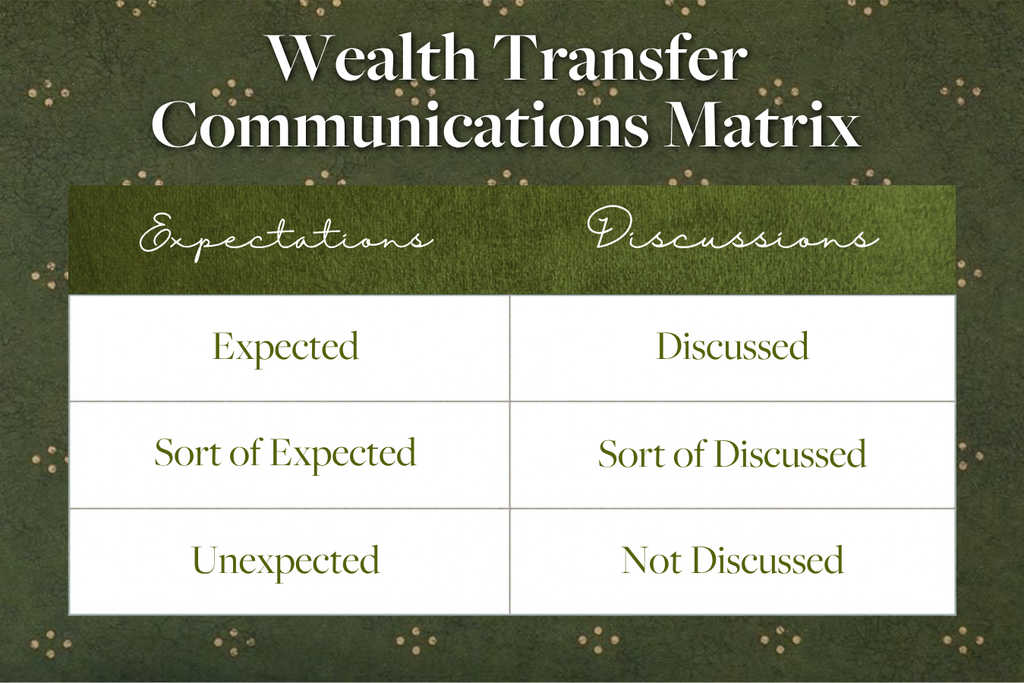
The matrix considers two important questions:
- Was the wealth transfer expected?
- Was the wealth transfer discussed?
These two factors can shape how prepared someone feels when wealth changes hands.
Think back to the individuals we’ve met throughout this series.
Sarina, from Part One, received an unexpected inheritance with little to no prior discussion. The news was both exciting and shocking.
Maria, from Part Two, had some expectation of receiving family wealth, but the conversations surrounding it were often unclear and emotionally painful.
Devon, whose business sale created a sudden financial transformation, had some time to anticipate the payout but little experience navigating the emotional impact of that level of wealth.
Each person has a different financial situation.
Yet all three are navigating the relationship between their financial reality and the beliefs, expectations, and experiences they bring to it.
Even when wealth is expected and openly discussed, difficult emotions can still arise.
Knowing money is coming doesn’t necessarily mean you’re emotionally prepared to receive it.
What Happens When Families Don’t Talk About Wealth Transfer?
This question also came up in my conversations with financial professionals at the FPA NexGen Conference.
I spoke with Stephanie from Sofia Financial, Cindy from Aging at 5280, Liz Windisch, CFP®, and Janice Guinn, CFP®, about what they’re seeing in their work with individuals and families navigating wealth transfer dynamics.
A recurring theme was how rarely these conversations happen before the transfer itself.
Sometimes the next generation has no idea wealth is coming. Other times, family members have expectations that don’t align with reality.
And when important questions remain unspoken, the emotional impact can be just as significant as the financial one.
Wendy: In your experience, how often is the wealth transfer process not talked about?
Stephanie: Nearly all the time! It’s not talked about—to the point that maybe the children, that next generation, don’t know anything’s coming. Or they think more is coming. Or they don’t really have an idea of what the numbers might mean to them.
Wendy: Anything you’d add, Janice, as far as your experience?
Janice: It’s not talked about unless the person you’re working with makes a point to have the conversation and get perspective on that. So I would say the majority of people we meet with have not addressed that.
Wendy: What happens, in your experience, when it’s not talked about?
Stephanie: The thing that comes to mind—maybe because it has struck me the most—is that the inheritors feel a great sense of responsibility and obligation: “I’m not worthy of this money.”
There’s a lot of emotional baggage that comes with it. As opposed to, I might imagine, if Great Aunt Myrtle told you that she was thrilled to give you this money to help you with your life goals or to help you buy that house you wanted. The emotional burden of it would be a lot less.
Wendy: And that’s pretty common, that the money’s not talked about?
Cindy: Maybe 95% of people do not speak to their parents about their financial situation. They don’t speak to their parents about where they want to receive care.
Wendy: How often is wealth transfer not talked about?
Liz: Eighty percent of the time—probably more. Almost never. Things would be a lot better on both ends if we changed that.
Wendy: In your experience, what happens when it’s not talked about?
Liz: There’s kind of the before and after.
Beforehand, children or inheritors may struggle a lot more than they need to because they don’t know that this money is coming, or they don’t feel that they can count on it. Perhaps they’re living very frugally, working so hard to save money, when maybe that wasn’t necessary.
On the other hand, it can be really difficult when people receive money that they didn’t know was coming because they don’t know what they’re supposed to do with it. They’ve already planned their life not counting on this.
It can be very overwhelming to have no idea that money is coming. Even if it’s not a large amount, anything that is a surprise is overwhelming.
Wendy: Having a financial planner or financial therapist kind of person to provide that non-judging space can be really helpful.
Liz: I would think a financial therapist isn’t going to be trying to sell you anything. They’re just there truly to help you.
Wendy: Just to listen.
I think these conversations are so valuable because they remind us that successful wealth transfer dynamics require more than documents, account information, and financial strategies.
It also requires understanding the people involved.
Their fears. Their expectations. Their relationships. And the Money Stories influencing how they communicate.
If you are avoiding, or find your family system is avoiding, a money conversation, you are not alone. In fact, you are in the majority! Kiplinger magazine, in its October 2026 edition, notes that “a smooth transfer of wealth requires a clear plan … Few families, however, have such a plan in place”.
“Most people take the ostrich approach: I’m going to stick my head in the sand and hope I never have to deal with this” – Kiplinger Magzter
How Your Money Story Can Influence What You Do With an Inheritance
Let’s return to Devon for a moment.
Imagine receiving more money than you’ve ever had in your life.
You might assume that financial security would immediately bring peace of mind.
But what if you’ve spent years believing there will never be enough?
What if money has always been associated with stress, shame, or conflict?
Suddenly having more resources doesn’t necessarily quiet those beliefs.
Instead, you might find yourself:
- Avoiding financial decisions because you’re afraid of making a mistake.
- Spending or giving money away to relieve uncomfortable feelings.
- Feeling guilty about having more than friends or family.
- Questioning whether you deserve your new financial circumstances.
- Seeking constant reassurance that you’re doing everything correctly.
These reactions can be confusing, especially when the outside world expects you to feel happy or grateful.
In my approach to financial therapy, we make room to understand what’s happening beneath those reactions.
And sometimes, that means exploring grief.
Not only grief over losing someone you love, but also grief over the conversations you never had, the support you didn’t receive, or the relationship you wish had been different.
You may never get the conversation you needed from a parent or family member.
But you can begin creating a different conversation with yourself.
One of My Favorite Money Story Exercises: Take the Money Word Out
Another of my 10 Principles of Financial Therapy© is:
Take the Money Word Out of the Sentence and Deepen What You Are Trying to Say.
I love this exercise because it helps us explore the deeper meaning behind statements that appear to be about money.
For example:
“I don’t want this inheritance.”
What might be underneath that statement?
- “I don’t want to feel connected to someone who hurt me.”
- “I’m afraid of the responsibility.”
- “I don’t believe I deserve this.”
Or consider:
“I’m afraid giving my children money will spoil them.”
Perhaps what you’re really saying is:
- “I want my children to develop values that matter to me.”
- “I’m afraid they won’t learn how to manage their own resources.”
- “I don’t know how to offer support without creating expectations.”
Here’s another:
“I’m worried my partner’s inheritance will change our relationship.”
Could that mean:
- “I’m afraid they won’t need me anymore.”
- “I worry our roles in the relationship will change.”
- “I don’t know what this means for our future together.”
Notice what happens when we look beneath the money language.
We begin identifying fears, desires, values, and relationship dynamics that may otherwise remain hidden.
And once we understand what we’re really trying to say, we have a better opportunity to communicate it.
What Does Support During a Wealth Transfer Actually Look Like?
Let’s return to Devon’s discovery call.
When Devon begins talking about the business sale and the amount of money they’ve received, they become emotional.
They share their history with debt and explain that their first instinct is to immediately pay off every outstanding balance.
It makes sense.
After years of financial stress, they want to finally do everything right.
But in my approach, we don’t begin by creating another set of rigid money rules.
We begin with curiosity.
What’s happening emotionally?
What does paying off the debt represent?
What beliefs are influencing the urgency Devon feels?
And what might it look like to allow some time to adjust to this new financial reality?
For Devon, one of the first steps is simply to Breathe.
To let the change sink in.
To keep the funds secure while allowing space to process the experience, reflect on their Money Story, and approach the next decisions with greater intention.
This doesn’t replace the practical work of financial planning.
In fact, I believe emotional support and practical financial guidance can work beautifully together.
Financial advisors, estate attorneys, tax professionals, and other members of your Financial A-Team can help you navigate the technical decisions.
My role is to help you understand the emotional patterns and beliefs that may influence how you approach those decisions.
Because when you better understand your relationship with money, you can begin making choices that reflect your own values rather than simply reacting to old fears.
Your Money Story Doesn’t Have to Decide What Happens Next
A wealth transfer can change your financial circumstances in an instant.
But understanding what that change means to you may take time.
You may need space to grieve, question old beliefs, navigate family expectations, or simply get comfortable with a new financial reality.
And you don’t have to figure everything out at once.
Through the Wendy Wright Financial Therapy Approach™, I help you explore the stories behind your financial decisions with abundant compassionate curiosity and zero judgment.
Because the goal is to help you develop a relationship with money that feels like your own.
You get to write the next chapter of your Money Story.
What’s Next in the Wealth Transfer Dynamics Series?
In Part Four, we’ll return to Sarina, Maria, and Devon to explore how the principles of my approach to financial therapy can be applied to their individual wealth transfer experiences. We’ll look at what it means to begin understanding your Money Story, navigating difficult emotions, and building a relationship with money that reflects your own values.
If you’re just joining the series, start with Part One: The Emotional Side of Receiving Wealth and continue with Part Two: Common Wealth Transfer Pain Points to explore the emotional and relational challenges that can arise when wealth changes hands.
And if you’re navigating a wealth transfer yourself, you don’t have to figure everything out alone. Book a free discovery call with me to explore how we might work together.
Want to Go Deeper into Wealth Transfer Dynamics?
Receiving or giving wealth can bring up far more than financial decisions. My Wealth Transfer Dynamics resource explores the emotional, financial, and intergenerational dynamics that can come with wealth transfer—including the thoughts, fears, communication patterns, and Money Stories that can surface along the way.
Frequently Asked Questions About Financial Therapy and Wealth Transfer
My approach to financial therapy helps you explore the emotional and relational experiences surrounding an inheritance. This can include grief, family expectations, financial anxiety, guilt, and long-standing Money Stories. Together, we work toward understanding these patterns so you can approach decisions with greater confidence and self-compassion.
Receiving money can activate beliefs about worthiness, responsibility, family loyalty, and what it means to have enough. These feelings may be connected to your personal history with money or the relationships surrounding the transfer. Exploring your Money Story can help you better understand where those emotions come from.
Yes. My approach can help individuals and families recognize the beliefs, fears, and expectations influencing their conversations about money. Understanding these patterns can support more intentional communication about giving, receiving, and managing wealth.
A financial advisor generally focuses on financial strategies, investments, and planning. My approach to financial therapy focuses on the emotional, psychological, and relational patterns that influence financial behavior. These two forms of support can complement each other, especially during significant financial transitions.
Absolutely not! You don’t need to be experiencing a wealth transfer or even a major financial change to benefit from my approach to financial therapy. Maybe you’re struggling with debt, spending more than you’d like, feeling guilty every time you make a purchase, or finding it difficult to spend money even when you have enough. Whatever your experience with money looks like, there’s a Money Story worth exploring. We start right where you are, with abundant compassionate curiosity and zero judgment, and begin understanding what’s underneath the patterns that may be keeping you stuck.