
By Wendy Wright, LMFT, Financial Therapist, Money Coach, and Money Story Specialist™ Founder of the Wendy Wright Financial Therapy Approach™ | Creator of the 10 Principles of Financial Therapy©
Have you ever promised yourself:
“This is the month I’ll finally stick to my budget.”
“I’ll never use my credit card again.”
“I’ll pay off my debt and never end up here again.”
In the moment, these money promises feel empowering. They give you hope that this time will be different.
Then life happens.
A surprise expense pops up. You forget about an annual bill. Vacation comes along. Your car needs repairs. You use your credit card one more time, overspend a little, or stop tracking your spending altogether.
Suddenly, the promise feels broken.
If you’ve found yourself repeating this cycle, you’re not alone—and you’re not lacking willpower.
More often, you’re caught in a cycle of perfectionism, shame, and unrealistic expectations that keeps you starting over instead of moving forward.
In this article, we’ll explore why money promises are so easy to make but so difficult to keep, why shame—not lack of discipline—is often the real obstacle, and how I have witnessed my financial therapy approach has helped women create lasting change.
Why We Make Big Money Promises
Have you noticed how often our money promises contain words like always and never?
“I’ll never eat out again.”
“I’ll always save every bonus.”
“I’ll never loan money again.”
These promises feel comforting because they temporarily relieve the anxiety we’re experiencing.
I like to call them magical promises.
Not because they’re foolish—but because they assume we can predict the future.
They imagine a version of life where nothing unexpected happens. No emergencies. No forgotten expenses. No emotional days. No setbacks.
For a moment, making the promise helps us feel like we’re in control.
That’s why we keep making them.
The problem isn’t the intention behind the promise.
The problem is that perfection isn’t sustainable.
Why Perfectionism Leads to Broken Money Promises
Perfectionism often disguises itself as motivation.
We think:
“If I can just get everything organized…”
“If I can just work harder…”
“If I can just stop making mistakes…”
…then everything will finally stay under control.
But money isn’t static.
Life changes.
Unexpected expenses happen.
Needs change.
Plans change.
Trying to create a perfect financial life is a little like cleaning out your garage in one exhausting weekend and promising yourself it’ll stay spotless forever.
At first, everything looks wonderful.
Then someone sets down a pair of shoes.
A holiday decoration gets stored.
A few boxes pile up.
Soon the garage starts looking lived in again.
That doesn’t mean you failed.
It means life continued.
Your finances work the same way.
The Real Cycle Behind Broken Money Promises
Here’s what often happens:
You make a big promise.
Something unexpected happens.
The promise becomes impossible to keep perfectly.
Then your inner dialogue changes.
“I messed everything up.”
“Why can’t I get this together?”
“Everyone else knows how to manage money except me.”
That’s when shame enters the picture.
Instead of responding with curiosity, we respond with criticism.
And shame almost always pushes us into one of two directions.
Some people become hypervigilant.
They obsess over every purchase, check their accounts constantly, and try to control every dollar.
Others move toward avoidance.
They stop opening bills, ignore their accounts, or tell themselves they’ll deal with it “later.”
Although these behaviors look different, they’re both protective responses.
Neither creates lasting peace with money.
🎥 Watch: Why Do I Keep Repeating the Same Money Patterns?
Why Willpower Isn’t the Answer
Many financial tips focus on discipline.
They promote that if you simply had “more willpower”, you’d finally stick to your plan.
But if willpower alone created lasting change, you wouldn’t still be struggling.
Most people already know what they “should” do.
They know they should save more.
Spend less.
Track their accounts.
Avoid unnecessary debt.
Knowledge isn’t usually the problem. Math isn’t the answer.
When money has become connected to fear, shame, perfectionism, or old emotional experiences, your nervous system is working hard to protect you.
That’s why financial change isn’t just about changing behaviors.
It’s also about understanding the beliefs and emotions driving those behaviors.
Moving From Shame to Compassionate Awareness
One of the foundational principles of the Wendy Wright Financial Therapy Approach™ is Abundant Compassionate Curiosity and Zero Judgment.
Instead of asking,
“What’s wrong with me?”
Try asking,
“What happened here?”
Notice what was happening emotionally before the promise broke.
Were you overwhelmed?
Exhausted?
Trying to comfort yourself?
Avoiding something difficult?
Feeling pressure to be perfect?
This shift—from judgment to curiosity—is where lasting change begins.
Build Smaller Promises That Build Self-Trust
Instead of making promises you can never realistically keep, begin making promises you can actually practice.
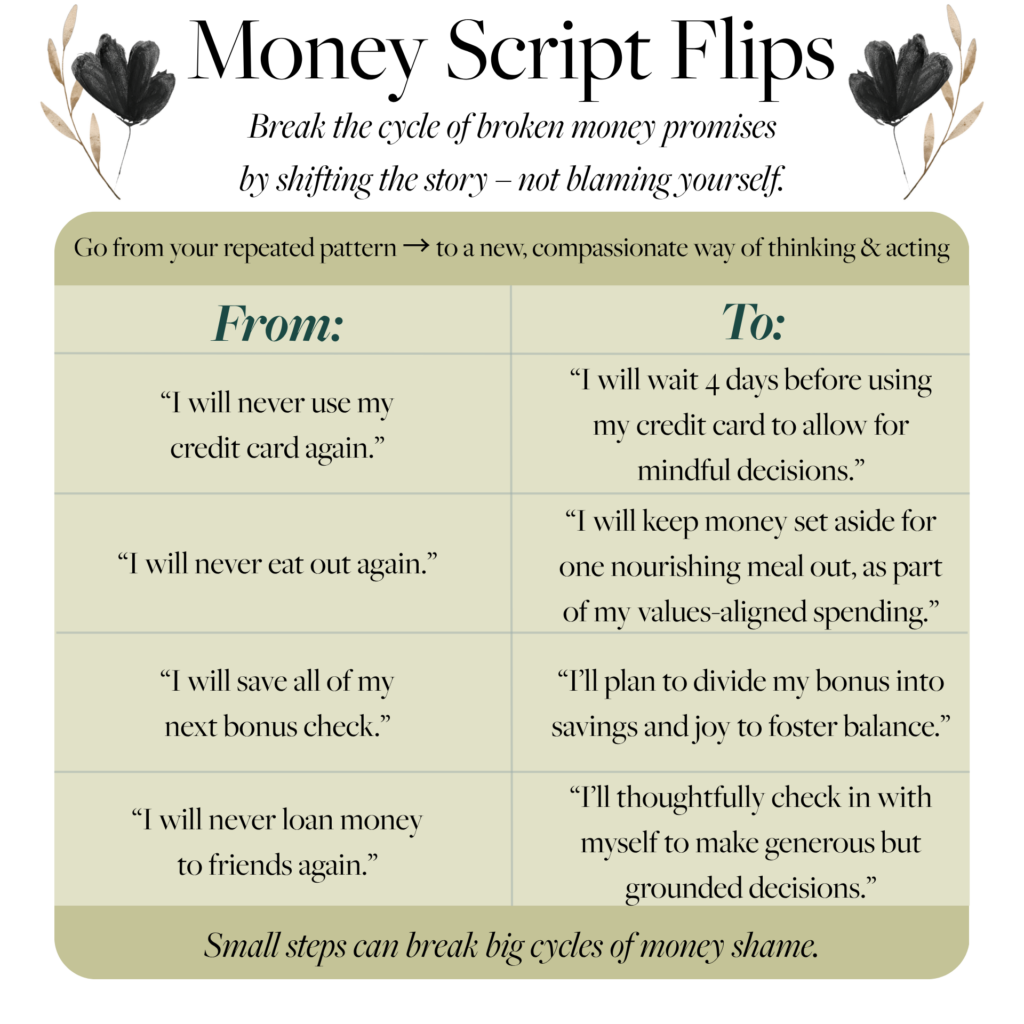
These aren’t smaller goals because you’re lowering your standards.
They’re smaller because they’re sustainable.
Small promises build self-trust.
Self-trust creates confidence.
Confidence creates long-term financial change.
Breaking the Cycle Starts With One Different Response
The goal isn’t to become perfect with money.
The goal is to stop believing that every mistake means you’ve failed.
Money will never be perfectly predictable.
Life won’t either.
When you replace perfection with compassion and build flexible plans instead of impossible promises, you begin creating a healthier relationship with money—one that’s based on trust instead of fear.
That’s where sustainable financial change happens.
If this cycle feels familiar, know that you don’t have to figure it out alone.
The approach I use, with Financial therapy at its core, helps you understand not only what you’re doing with money, but why. Together, we can uncover the patterns keeping you stuck and create practical, compassionate strategies that actually last.
Ready to Take the Next Step?
If you’re ready to break free from the cycle of broken money promises and build a healthier relationship with money:
- Download my FREE Money Calm Checklist for a simple first step toward feeling more grounded.
- Take the Money Shadow Quiz to discover the hidden beliefs influencing your financial decisions.
- Book a free 20-minute Discovery Call to explore whether financial therapy is the right next step for you.
Frequently Asked Questions
Many people assume they lack discipline, but repeated broken money promises are often driven by perfectionism, shame, and emotional patterns—not a lack of willpower. When every setback feels like failure, it’s easy to give up and start the cycle over again. Financial therapy helps uncover the underlying patterns so you can create lasting change.
Sticking to a budget isn’t just about numbers—it’s also about emotions, habits, and expectations. If your budget is based on perfection or unrealistic rules, it’s more likely to fall apart when life happens. A flexible financial plan is often more sustainable than trying to follow a perfect budget.
Yes. Perfectionism can lead to all-or-nothing thinking, such as believing you’ve failed because you overspent once or forgot to track your spending. This mindset often creates shame, avoidance, or over-controlling behaviors that make long-term financial progress more difficult.
A money stress cycle happens when financial anxiety leads to unrealistic promises, followed by setbacks, self-criticism, and either avoidance or hypervigilance. Without addressing the emotional pattern underneath, the cycle often repeats.
Financial therapy combines emotional insight with practical financial strategies. Rather than focusing only on budgeting or saving, it explores the beliefs, experiences, and emotions that influence your financial decisions so you can build healthier, more sustainable habits.
Traditional financial advice often focuses on what you should do with your money. Financial therapy explores why certain money behaviors keep repeating. By understanding your money story, emotional triggers, and relationship with money, you can make financial decisions that align with your values and goals.